

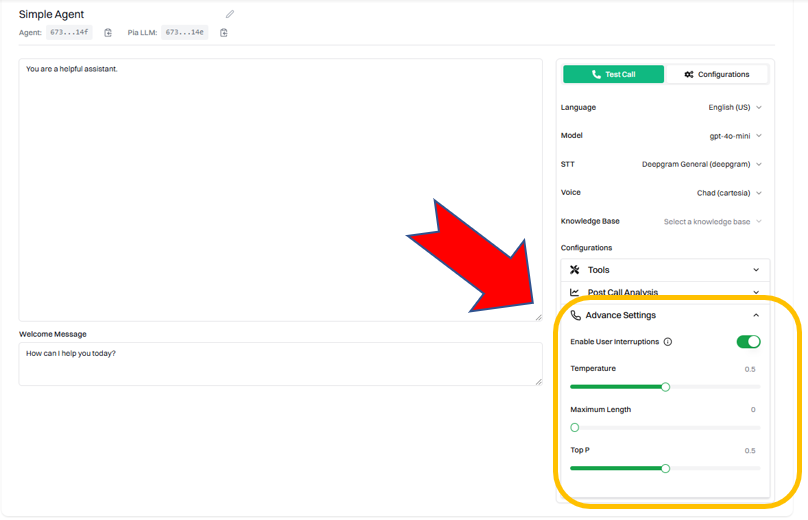
1. Advanced Agent Settings
These settings control how long calls last and how the agent handles conversations when callers stop responding.End Call Delay
Default: 2 seconds Sets how long the agent waits before actually disconnecting a call after deciding to end the conversation.- A lower value disconnects the call quickly.
- A higher value gives the caller a little more time before the call ends.
Silence Reminder
Default: Disabled Allows the agent to automatically remind callers to respond when there is no activity or speech during a call. When enabled, the agent periodically prompts the caller instead of waiting silently. Related settings:- Reminder Duration: How long the caller must remain silent before the agent sends the first reminder.
- Max Number of Reminders: The maximum number of reminders the agent can send during a silent period.
- Interval Between Reminders: How long the agent waits between consecutive reminders.
End Call Instruction
Allows you to provide custom instructions describing when and how the AI agent should end a call. You can define specific conditions or scenarios in which the agent should politely conclude the conversation. Example: “Thank the caller for their time, ask if they need any further assistance, and politely end the call if they have no additional questions.” If left blank, the agent follows its default call-ending behavior.Maximum Call Duration
Default: 1800 seconds (30 minutes) Sets the maximum amount of time a call can remain active. Once this limit is reached, the call will end. Example: Setting this value to 600 seconds limits each call to 10 minutes.Welcome Message Delay
Default: 2 seconds Controls how long the agent waits before delivering its welcome message after a call starts. Example: If set to 3 seconds, the agent waits 3 seconds before greeting the caller.2. Conversation & Interruption Settings
These settings control how the agent listens and responds while the caller is speaking.Enable User Interruptions
Default: Enabled Allows callers to interrupt the AI agent while it is speaking.- Enabled: The agent can stop speaking and listen when the caller starts talking.
- Disabled: The agent finishes its response before listening to the caller.
Minimum Words for Interruption
Default: 2 words Sets the minimum number of words a caller must say before the agent recognizes their speech as an interruption.- A lower value makes the agent more responsive to short interruptions.
- A higher value helps prevent background noise or very short sounds from interrupting the agent.
Voice Detection Sensitivity
Default: 0.5 Controls how sensitive the agent is when detecting a caller’s voice.- Higher sensitivity: Detects softer voices but may also pick up background noise.
- Lower sensitivity: Ignores more background noise but may miss quiet or soft-spoken callers.
Adaptive Interruption
Allows the agent to ask callers whether they want to interrupt or simply continue speaking, rather than immediately stopping its response.This feature currently supports Japanese and Bengali only. The agent’s language must be set to one of these supported languages.
3. Voice & Speech Settings
These settings control how the AI agent sounds and how its responses are generated.Speech Speed
Default: 1.0 Controls how quickly the AI agent speaks.- Below 1.0: The agent speaks more slowly.
- 1.0: Normal speaking speed.
- Above 1.0: The agent speaks faster.
Temperature
Default: 0.1 Controls how predictable or creative the agent’s responses are.- Lower values: More consistent and predictable responses.
- Higher values: More varied and creative responses.
Maximum Length
Default: 4096 tokens Sets the maximum number of tokens the AI model can generate in a single response.- A lower value limits response length.
- A higher value allows the agent to generate longer responses.
This is a model response-generation limit, not a limit on the total duration of the call.
4. Background Audio Settings
These settings control the background sound during calls.Ambient Sound
Allows you to select a background sound that plays during calls. Example: You can select a suitable ambient sound to make calls feel more natural, or choose None to keep the call free from background audio.Ambient Sound Volume
Default: 1 Controls the loudness of the selected background sound relative to the agent’s voice.- A lower value makes the background sound quieter.
- A higher value makes it louder.
5. Voicemail Settings
These settings help the agent identify voicemail or answering machines.Voicemail Detection
Default: Disabled Allows the agent to detect whether a call has been answered by a voicemail system or answering machine instead of a real person. When enabled, the agent can recognize voicemail and leave a message instead of continuing a normal conversation.Voicemail Message
Allows you to configure the message the agent should leave when voicemail is detected. Example: “Hello, this is a call from ABC Company. We are reaching out regarding your recent inquiry. Please call us back when convenient. Thank you.”This setting is relevant only when Voicemail Detection is enabled.
6. Agent Timezone
Allows you to select the timezone the AI agent should use when interpreting the current date and time. This is particularly important when the agent needs to discuss appointments, schedules, business hours, or time-sensitive information. Example: SelectAsia/Dhaka if the agent operates according to Bangladesh Standard Time.
If no timezone is selected, the agent uses the platform’s default timezone.
7. Pronunciations
Allows you to teach the AI agent how to pronounce specific words, names, or terms correctly. This is useful for company names, product names, people’s names, abbreviations, or industry-specific terminology. Example:- Word: Verbex
- Pronunciation: Your preferred pronunciation of the word.